Issue VI (June 2026)
Contents
The Unraveling of a Model: Germany’s Industrial Contraction as a Microcosm of the Global Economic Slowdown
Haoyu Yang
The world economy in the mid-2020s faces a structural slowdown—one rooted in deep, enduring shifts rather than temporary fluctuations that monetary or fiscal policy can easily reverse. Unlike cyclical downturns, which stem from demand shortages and resolve through stimulus, structural slowdowns arise from supply-side fractures: disrupted trade networks, energy transitions, and technological realignments. Germany, Europe’s largest economy and a central node in global value chains, experiences this crisis in amplified form—a caricature that exaggerates the global malaise. With real GDP contracting by 0.3 % in 2023 and remaining flat throughout 2024 (Destatis, 2025), Germany has entered a prolonged stagnation unseen since the early 2000s. This is not merely statistical noise; it reflects the breakdown of a growth model that once powered both national prosperity and European integration. As the world’s fourth-largest exporter and a supplier of intermediate goods (e.g., precision machinery, chemical inputs) to over 80 % of global manufacturing sectors, Germany’s distress sends ripple effects far beyond its borders, making it a diagnostic lens for the broader structural crisis.
At the heart of Germany’s crisis is the irreversible collapse of its postwar economic architecture: an export-led, energy-intensive growth model built on two pillars—cheap Russian natural gas and insatiable Chinese demand—now shattered by three simultaneous shocks. First, the permanent loss of low-cost Russian gas following the 2022 Ukraine invasion and Nord Stream sabotage ended a decades-long energy bargain. Industrial gas prices, once €20/MWh, stabilized at €45/MWh—125 % above pre-crisis levels (BAFA, 2025)—devastating energy-intensive sectors like chemicals (60 % energy cost share) and fertilizers (70 %). Second, China’s transformation from customer to competitor has eroded Germany’s export engine. Once absorbing 19 % of German exports (especially premium automobiles), China’s push for self-sufficiency—via subsidies for BYD, NIO, and CATL—has slashed German automakers’ market share from 34 % in 2018 to 22 % in 2024 (VDA, 2025). Third, the European Central Bank’s aggressive rate hikes from –0.5 % to 4.5 % (2022–2023) raised real borrowing costs to 5.2 %, freezing Mittelstand investment in automation and green tech (Bitkom, 2025). These shocks are not isolated; they interact—high energy costs reduce competitiveness, lost Chinese sales shrink revenues, and tight money blocks reinvestment—forming a self-reinforcing contraction cycle.
The German downturn is not contained. As the Eurozone’s industrial core (29 % of manufacturing value added), Germany transmits weakness through tightly integrated supply chains. A 1 % decline in German industrial production reduces Italian machinery exports by 0.6 %, Polish auto-parts output by 0.8 %, and Dutch logistics GDP by 0.4 % (ECB input-output model, 2024). The European Commission estimates this subtracted 0.4 percentage points from Eurozone growth in 2024 alone (Autumn Forecast, 2025). This spillover reflects asymmetric integration: peripheral economies depend on German demand, but Germany cannot rely on them for growth. The result is a regional amplification loop—German factory closures → fewer orders → layoffs in supplier nations → reduced Eurozone consumption → further pressure on German exports.
Far from a routine recession, Germany’s crisis is a controlled experiment exposing the fragility of pre-2020 globalization paradigms: just-in-time supply chains, energy interdependence, and export-led growth under stable geopolitics. The German model assumed perpetual access to cheap inputs and open markets—assumptions now obsolete. With export income elasticity to Chinese GDP at ~2.1 (IMF, 2024), small shifts in Beijing trigger large swings in Berlin. The ECB faces a policy trilemma—ease to save Germany and risk southern inflation, or hold firm and deepen deindustrialization. Germany’s struggle thus foreshadows a broader reckoning: resilience now trumps efficiency. The world must pivot from global optimization to national robustness—diversifying energy, nearshoring critical inputs, and investing in sovereign tech. Germany is not an outlier; it is the canary in the coal mine of a fragmenting economic order.
Germany's post-war economic ascent, more commonly referred to as the Wirtschaftswunder, was anchored architecturally on two interdependent supports that synergistically propelled decades of export dominance and fiscal surplus. The first was access to inexpensive and reliable Russian natural gas, which, pre-2022, constituted fully 40% of the nation's total gas supply, allowing energy-intensive industries to produce at costs impossible for competitors in North America or Asia. The second pillar was unrestricted entry into the rapidly expanding Chinese market, which, by 2021, absorbed 19% of all German exports, transforming Beijing into Berlin's most lucrative external demand source. These sectors-chemicals, metals, and machinery-collectively generated 28% of manufacturing value added and underpinned a current-account surplus equivalent to 8% of GDP, a figure that underlined Germany's role as the Eurozone's creditor-in-chief (Eurostat, 2023). It was precisely this very architecture that, in delivering an unparalleled competitive edge via low marginal costs and high-margin sales, embedded a twin set of external dependencies that rendered the model exquisitely sensitive to geopolitical rupture. The reliance upon a singular source of energy and a single growth market created latent fragilities that, while masked by pre-2020 globalization, were never eliminated, and which have set the scene for a cascading crisis once exogenous shocks materialized.
The first pillar did not just disintegrate but did so with dramatic suddenness in February 2022, when the Russian invasion of Ukraine precipitated the deliberate destruction of the Nord Stream pipelines, severing the physical conduit for low-cost gas imports. Industrial gas prices, which had averaged €20 per megawatt-hour in 2021, rocketed to a peak of €120/MWh in the third quarter of 2022 before retreating to a new equilibrium of €45/MWh—still an astonishing 125 % above pre-crisis levels, as shown in BAFA (2025). This was no transient spike but a permanent structural repricing, with Germany pivoting to LNG imports from Qatar, the United States, and Norway at premiums dictated by global spot markets and long-term contracts devoid of the geopolitical discounts once negotiated with Gazprom. The immediacy of the shock exposed the fragility of an industrial base calibrated for energy costs that were no longer economically or politically viable, initiating a chain reaction across downstream sectors where energy inputs are non-substitutable in the short to medium term.
The chemicals industry, in which energy costs represent some 60 % of the production value, was at the epicenter of this energy shock, with profit margins shrinking by 42 percentage points between 2022 and 2024 as input price increases raced ahead of the ability to pass through costs downstream in a globally oversupplied market. This widened to a dramatic 58 percentage point margin collapse for fertilizer producers, for whom energy costs account for 70 % of the costs, forcing companies like Yara to announce the indefinite closure of European ammonia plants. For steel producers, reliant on electric arc furnaces and gas-based direct reduction, the decline reached 31 percentage points, which has inspired capacity cuts at historic sites such as Salzgitter. These margin compressions were anything but cyclical; they occasioned contraction on the supply side as firms postponed maintenance, reduced shifts, and idled high-cost lines. The net impact was the squeeze of industrial capacity utilization from 85 % in 2021 down to below 70 % by mid-2024, which constituted the most significant deindustrialization episode since the 1970s oil crises.
BASF, the world’s largest chemical producer and a bellwether for German industry, encapsulated the irreversible nature of this relocation in its announcement of a €1 billion permanent cost-reduction program at its flagship Ludwigshafen complex—the largest single industrial site in Europe. This initiative included workforce reductions of 2,600, the shutdown of energy-intensive caprolactam and TDI plants, and the redirection of €4 billion in planned capital expenditure to new Verbund sites in Zhanjiang, China, and Geismar, Louisiana (BASF IR, 2023–2025). The decision was not framed as a temporary austerity measure but as a strategic reorientation toward jurisdictions offering energy costs 30–50 % lower and regulatory environments more permissive of carbon-intensive processes. This exodus of flagship investment signals a hollowing-out of the industrial core, as knowledge, patents, and supply-chain ecosystems migrate alongside capital, diminishing Germany’s status as a high-value manufacturing hub and eroding the tax base that once funded its social model.
Concurrently, the second pillar—China’s role as an insatiable growth market—began to crumble as Beijing’s economic strategy pivoted from import-led expansion to domestic self-sufficiency under the dual circulation framework. German automakers, long the beneficiaries of Chinese middle-class aspiration for premium brands, saw their collective market share in the world’s largest auto market plummet from 34 % in 2018 to 22 % in 2024, displaced by state-subsidized domestic champions such as BYD, NIO, and Li Auto (CAAM, 2025). Volkswagen, once the volume leader, surrendered 12 percentage points of share and responded by forming a joint venture with XPeng to co-develop electric architectures, effectively transferring software and platform expertise. BMW, down 9 percentage points, localized production of the iX3 in Shenyang to qualify for subsidies while ceding battery and powertrain IP (VDA, 2025). These moves, while tactically necessary, accelerate China’s technological catch-up and transform a former growth engine into a strategic rival in the very segments—electromobility and intelligent vehicles—that Germany had earmarked for its next industrial chapter.
The competitive chasm is stark: German premium EVs command average transaction prices of €40,000, while BYD’s Qin Plus starts at €25,000 with comparable range and features, rendering Teutonic engineering economically unviable for mass segments (CAAM pricing database, 2025). China’s dual circulation policy—prioritizing domestic supply chains and consumption—has been supercharged by subsidies exceeding €200 billion since 2020, enabling vertical integration from lithium refining to battery gigafactories. German firms, compelled to localize to access these incentives, engage in forced technology transfer that erodes their core intellectual property moats. Quantitatively, the elasticity of German export volumes to Chinese GDP growth now stands at approximately 2.1 (IMF Direction of Trade Statistics, 2024), meaning that a modest 1 % deceleration in Chinese final demand triggers a disproportionate 2.1 % contraction in German shipments. This amplified transmission mechanism transforms China’s structural slowdown—projected at 4.5 % annual growth through 2030—into a chronic drag on German external accounts.
Compounding these external shocks, the European Central Bank executed one of the most aggressive tightening cycles in its history, elevating policy rates from –0.5 % in July 2022 to 4.5 % by September 2023 in a bid to anchor inflation expectations. Real borrowing costs for non-financial corporations surged to 5.2 %—the highest since the 2008 sovereign debt crisis—forcing a credit crunch on the Mittelstand, the constellation of 3.5 million small and medium-sized enterprises that employ 60 % of the workforce and file 99 % of patents (ECB Bank Lending Survey, 2025). Investment as a share of gross value added collapsed from 18 % in 2021 to 12 % in 2024, while spending on digitalization—crucial for Industry 4.0 transitions—plummeted from €22 billion to €14 billion annually (Bitkom, 2025). High capital costs defer automation rollouts, delay grid-scale battery storage projects, and postpone carbon capture initiatives, locking firms into legacy cost structures at precisely the moment competitors in Asia and North America accelerate decarbonization and AI integration.
Germany’s industrial malaise radiates inexorably across the Eurozone, given its outsized 29 % share of regional manufacturing value added. Input-output modeling reveals that a 1 % decline in German industrial production cascades into a 0.6 % reduction in Italian machinery exports, a 0.8 % drop in Polish auto-parts output, and a 0.4 % contraction in Dutch logistics GDP (ECB, 2024). The European Commission quantifies the aggregate growth drag at 0.4 percentage points for 2024 alone, transforming a national crisis into a continental headwind (Autumn Forecast, 2025). This transmission operates through asymmetric interdependence: peripheral economies supply intermediates to German assemblers but lack the domestic demand to offset lost orders. The result is a self-perpetuating loop—German factory closures beget supplier insolvencies, which erode Eurozone consumption, which further depresses German export prospects—illustrating how integration, once a growth multiplier, now functions as a vulnerability amplifier in an era of deglobalization.
Policymakers are confronted by a classic trilemma: hitting the 2% inflation target, alleviating German industrial distress, and preserving the debt sustainability of the southern member states. Premature easing threatens core inflation overshooting; prolonged restraint risks deindustrialization. A structural pivot is unavoidable: €200 billion in LNG terminals and grid upgrades (BMWK, 2025), pursuit of EU–India and Mercosur trade agreements to offset a targeted 15 percentage points reduction in China export dependence by 2030, and a €50 billion Zukunftsfonds for AI and green technology (2024 Federal Budget).
Germany's contraction is not a standard recession but a balance-of-payments crisis in slow motion. And because machinery exports to China come with an income elasticity of more than 2, global shocks are amplified, not absorbed. The pre-2020 model of cheap energy, Chinese demand, and loose money has irreversibly collapsed. The global slowdown is therefore structural: resilience now replaces efficiency. Supply-chain redundancy and energy sovereignty will have to replace interdependence laced with vulnerability. In this regard, Germany's painful adaptation provides a cautionary preview for other advanced economies of what it will mean when the era of easy growth gives way to a far more arduous chapter.
United States: Political Polarisation and Its Impact on Economic Stability
Eason Huang
Background Information
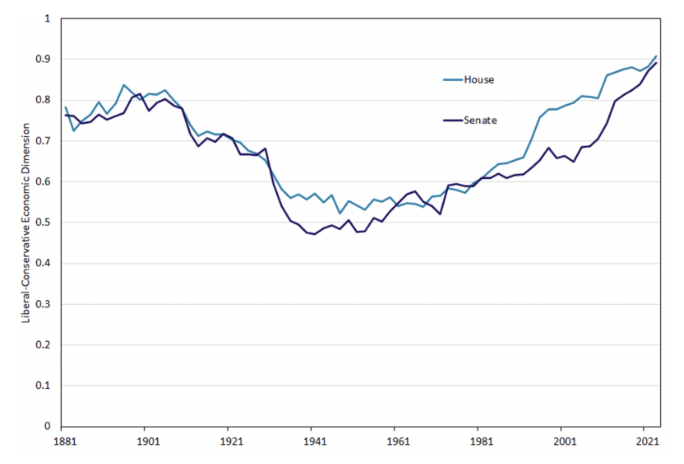
Political division has intensified in the US in recent decades. Pew Research reveals a sharp increase in political polarisation: in 2022, 72% of Republicans and 63% of Democrats viewed the opposing party as more hostile than before, up dramatically from 47% and 35% in 2016 (Stirling). The 2024 presidential election further amplified this division. With Donald Trump and Kamala Harris competing for president, US voters became increasingly hostile to each other. They pushed the opposing parties towards ideological extremes rather than the moderate middle ground. Moreover, the Partisan Conflict Index (PCI) shows rising disagreement since 2007, achieving a historical high in 2021 (Azzimonti). The growing political polarization is attributed to the genuine frustrations with government, the economy, and inequalities of wealth and opportunity. People tend to treat members of the opposing party as more immoral than they are, causing a growing range of policy differences between Democrats and Republicans ("United States").
Economic Instability

Political polarization has led to frequent debates and impasses in Congress, delaying approvals and economic policies. The delays in critical fiscal policies, such as budgets, debt, tax, create an unpredictable threat to US economic stability. To begin with, the deep ideological divide has made a consensus between the two parties nearly impossible. This results in frequent government impasses, delaying essential economic legislation related to budgets and long-term reforms. For example, in 2021, Democrats almost failed to pass a $1.9 trillion fiscal policy for economic reform, as there was no Republican support (VIJLDER). This example suggests that economic relief policies cannot be implemented when there is political division. Furthermore, the political division can cause dampened investment. For businesses, political volatility creates an unpredictable environment. When partisan conflict is high, companies postpone investments in capital and hiring due to fears that major policies could abruptly shift with the next election. This seriously discourages innovation for investors and corporations that depend on stable tax rules.
Impact on People
Families on government assistance programs face dire economic circumstances when the government cannot pass its budget on time, as unemployment benefits and social programs are in limbo. In 2021, the near-collapse of the $1.9 trillion economic relief package illustrates the extent of the damage that partisan gridlock can inflict on the American public when they need economic relief most. Delays in critical containment and structural measures represent the extent of the damage that can be caused by political gridlock in America.

Conclusion
The American people, including workers and job seekers, suffer from the aftereffects of the economic instability caused by businesses that are uncertain about the future of America. When businesses are uncertain about the future of America, hiring opportunities are reduced. Moreover, entrepreneurs cannot expand their businesses because of the unpredictable nature of tax laws that can change at the end of each election cycle. The American people face an uncertain future because of the effects of political gridlock in America. For the American people, economic growth and stability are threatened by the unpredictable nature of America’s future, as government programs are hostage to partisan gridlock in America.
In essence, political polarization acts as a corrosive force on economic foundations by causing gridlock and uncertainty. The political division discourages the investment needed for stable growth. Simultaneously, it deepens the social inequality while preventing legislative action to heal it. This interplay creates a feedback loop that poses a fundamental threat to the nation's long-term economic health and social cohesion. The data “one in 10 of our respondents thinks that the government represents them well (Rosenstiel),” further exemplifies how widened political division can lead to a lack of confidence in the government. If no further actions are taken, the risk of long-term economic consequences, including slower growth and weakened international trade, will continue to rise.
Works Cited
Azzimonti, Marina. "Partisan Conflict in the U.S. and Potential Impacts on the Economy." Federal Reserve Bank of Richmond, June 2023, www.richmondfed.org/publications/research/economic_brief/2023/eb_23-20. Accessed 15 Jan. 2026.
Clemens, Austin. "Eight graphs that tell the story of U.S. economic inequality." Washington Center for Equitable Growth, 9 Dec. 2019, equitablegrowth.org/eight-graphs-that-tell-the-story-of-u-s-economic-inequality/. Accessed 15 Jan. 2026.
Kang, Youngho. "Political polarization, state capacity, and economic growth." ScienceDirect, Dec. 2025, www.sciencedirect.com/science/article/abs/pii/S0939362525000457. Accessed 15 Jan. 2026.
Rosenstiel, Tom. "To understand how Americans engage with government, news, civic life, and each other, researchers need to more broadly study their attitudes." NORC at the University of Chicago, Jan. 2025, www.norc.org/research/library/while-politics-divide-country-americans-share-profound-sense-distrust.html. Accessed 15 Jan. 2026.
Stirling, Diane. "The 'Great Divide': Understanding US Political Polarization." Syracuse University Today, Oct. 2025, news.syr.edu/2025/10/23/the-great-divide-understanding-us-political-polarization/. Accessed 15 Jan. 2026.
"United States: Political Polarisation and Its Impact on Economic Stability." specialeurasia, www.specialeurasia.com/2025/03/24/united-states-polarisation/. Accessed 15 Jan. 2026.
VIJLDER, William DE. "United States: The economic consequences of political polarization." BNP Paribas, 26 Feb. 2024, economic-research.bnpparibas.com/html/en-US/United-States-economic-consequences-political-polarization-2/26/2024,49371. Accessed 15 Jan. 2026.
Voorheis, John. "Unequal Incomes, Ideology and Gridlock: How Rising Inequality Increases Political Polarization." Princeton University, 2015, rppe.princeton.edu/publications/unequal-incomes-ideology-and-gridlock-how-rising-inequality-increases-political. Accessed 15 Jan. 2026.
The Hidden Carbon Cost of the Cloud
Sam Wang

Introduction
In an age where almost everything we do depends on the internet, there’s a hidden world powering all of it. Many people imagine the “cloud” as something weightless, but in reality the cloud is grounded in massive physical facilities called data centers. These facilities are essential for our daily lives, yet they also come with significant environmental challenges as demand for digital services grows worldwide. Some experts even warn that data centers could one day consume more electricity than entire countries, a sobering thought given global sustainability goals. However, understanding how data centers intersect with sustainability isn’t just about nature - it’s equally about economics, energy systems, and the future of responsible growth in an evolving world.
Data Centers - What Are They?
Data centers are physical facilities that store, process, and deliver digital information and services. Far from mysterious “clouds”, they are real buildings filled with powerful computers and networking equipment that keep the internet functioning. What makes data centers especially important today is how central they are to nearly every part of modern life and the economy. Businesses of all sizes rely on them to run their applications, from inventory systems to customer-service platforms, and to manage large volumes of data. On a broader scale, governments, healthcare systems, and banks use them to host critical services and protect sensitive information. Without data centers, many of the conveniences people take for granted would simply stop working (“What is a Data Center?”). Furthermore, data centers also support the cloud services economy that has transformed how companies operate. Rather than buying and maintaining their own expensive computing infrastructure, many organizations rent space and computing power in large, shared data centers operated by cloud providers like Amazon Web Services or Microsoft Azure. This makes IT resources more flexible, as organizations can grow or shrink their capacity based on real-time demand without huge upfront investment (Susnjara and Smalley).
A Cost for the Environment
Despite enabling a largely digital economy, data centers have a substantial and growing environmental footprint due to their intensive use of energy and water. Globally, data centers account for around 1-2% of total electricity consumption, a share that could more than double by 2030 as cloud computing and AI expand rapidly. This energy demand is driven by the need to operate continuously and to power cooling systems that prevent overheating. In countries such as the United States, data centers already consume about 4% of national electricity, placing strain on power grids and increasing demand for new energy infrastructure. Additionally, when the electricity used by data centers is generated from fossil fuels, this high energy demand translated into significant emissions: globally, data centers produce over 200 million tonnes of CO2 annually, a figure expected to rise if cleaner energy sources are not adopted at scale. Beyond electricity, many data centers rely on water-based cooling systems, with large facilities using millions of gallons of water per day, often in regions already facing water scarcity - raising concerns about competition with local communications and agriculture. These statistics not only expose the environmental implications of data centers, they also highlight a core economic challenge: how to support digital growth while managing scarce resources and limiting negative externalities.
Neoliberalism, War, and Global Slowdown
Dominic Gao and Nelson Bai
In the early 21st century, neoliberalism emerged as the dominant global economic ideology. Led by leaders like Reagan and Thatcher, neoliberalism was presented as a solution to the stagflation that had plagued the global economy in the 70s. It emphasises free markets, deregulation, privatisation, and globalization to foster prosperity and, theoretically, peace through interdependence. Rooted in the capitalist peace theory, economists such as Milton Friedman theorized that economic integration reduces conflict by raising the costs of war and aligning interests among trading partners. Yet, as a variety of sources indicate; neoliberalism's success in curbing war has been limited at best, rather it has been undermined by persistent conflicts, rising inequality, and geopolitical tensions. Data from the Uppsala Conflict Data Program (UCDP) supports this to some extent: interstate wars, defined as armed conflicts between states causing at least 1,000 battle-related deaths annually, declined sharply after 2000. From 2000 to 2025, UCDP recorded only 8-12 such wars per year, compared to peaks of over 20 in the late 20th century. This drop aligns with a surge in global trade, which doubled as a share of GDP from 1990 to 2008, before stabilising. The Stockholm International Peace Research Institute (SIPRI) notes that while military expenditure as a percentage of GDP fell in many regions post-Cold War, the overall global burden remained around 2.5% by 2024, which suggests there has been a deterrence to a degree through economic stakes rather than disarmament.
However, neoliberalism's success in curbing war has been partial and, often, potentially problematic. Although at a global scale, interstate conflicts have reduced due to the prevalence of interdependent economies, UCDP data shows active armed conflicts rising from 31-39 annually in the early 2000s to 52-56 since 2015, reaching 55 state-involved conflicts in 2022 and over 150 ongoing by 2025. This escalation stems primarily from several main reasons. Firstly, neoliberal policies exacerbate inequality and social fragmentation. World Bank figures indicate extreme poverty fell from 43% in 1980 to 8% by 2023, lifting over a billion people, yet income inequality surged, with the top 1% capturing disproportionate gains. In regions like sub-Saharan Africa and Latin America, structural adjustment programs imposed by the IMF and World Bank exacerbated local economic vulnerabilities and fueled the rise of resource-based conflicts and ethnic tensions. SIPRI reports global military spending hit $2,718 billion in 2024, a 37% rise since 2015, driven by hybrid threats like cyber warfare and proxy conflicts in modern decoupled trade landscapes.
Neoliberalism's role in spurring authoritarianism further undermines its peace dividend. Economic liberalization has brought prosperity to swaths of people but delivered precarity, leading to eroding trust in democratic institutions. Freedom House reports a global democratic recession since 2006, with authoritarian regimes rising in tandem with inequality. Studies link import shocks from globalization to support for illiberal populists, as seen in the U.S. Rust Belt and Europe's far-right surges. In Brazil, Hungary, and Turkey, "authoritarian neoliberalism" emerged, integrating market freedoms, but not too bringing about the democratic freedoms promised by Capitalist Peace theory. The 2008 financial crisis exposed the fragility of interdependent economies paving the way for populist figures like Trump and Bolsonaro, who weaponised anti-globalisation rhetoric using increased inequality brought about by the rise of neoliberalism to justify conflict and the .
Now, neoliberalism faces a global economic slowdown partly of its own making. IMF projections forecast world GDP growth at 3.1% in 2026, up slightly from 3.0% in 2025 but below pre-2008 averages, amid divergent paths: U.S. growth at 2.0%, China slowing to 4.1%, and Europe at 1.2%.
The 2007-2009 Global Financial Crisis (GFC) and the "Great Recession"
Sofie Tse
In September 2008, as the Lehman Brothers, a well-known global investment bank, filed for bankruptcy, a London-based fund manager made a frantic call to the U.S treasury. "There is a complete, unmitigated lack of liquidity, the system is shutting down.” This moment of frozen credit was beyond just a Wall Street Catastrophe; it was a global economic downturn that would wipe out trillions in wealth and redefine the 21st century.
The global financial crisis of 2007-2010 stemmed from real estate. After the United States began recovering from the 2001-2004 recession, housing prices saw exponential growth, and political leaders saw the upside of home ownership: more homes purchased meant more jobs and more consumer spending. Expectations that housing prices would continue rising incentivised households in the United States, and European property developers to borrow excessively to purchase and build houses. Often, mortgage loans, especially in the U.S, came near to or even exceeded the purchase price of a house. Banks and lenders were willing to make loans of such large volumes because of two main reasons. First, the perceived profitability stemming from competition between lenders amidst a favourable economic environment. Second, minimal incentive to assess borrowers’ ability to repay, especially when selling ‘mortgage-backed securities’, as they were rated secure by various external agencies. Excessive risk-taking in a favourable macroeconomic environment and flush with cheap credit from global savings imbalances, created a fragile structure of debt. In turn, as the “housing bubble” burst, and prices began dropping, a rising number of borrowers were unable to repay their loans. Clear stresses in the financial system came to light around mid 2007, as some lenders and investors began to incur large losses because many of the houses they repossessed were priced below the value of initial loans. Moreover, because foreign banks were active participants in the US housing market and US banks had substantial global operations, financial failures in the US housing market spilled over to financial systems and economies in other countries. In September of 2008, Lehman Brothers filed for bankruptcy, and the peaking of financial stress followed. Combined with the failure of multiple corporations, investors began pulling their money out of banks and investment funds as they were unaware of how exposed each institution was to subprime loans. Hence, financial markets became dysfunctional as everyone tried to sell at the same time, and many institutions vied for funding but were unsuccessful. Simultaneously, businesses became less willing to invest while households became less willing to spend as confidence collapsed. As a result, the United States and several other economies fell into one of their deepest recessions since the Great Depression.
This initiated a global race to stabilize and stimulate economic activity, with nations deploying measures from multi-trillion-dollar bailouts and quantitative easing to wage subsidies and infrastructure investment. The success of these measures were dictated by domestic political constraints, institutional flexibility, and pre-existing economic strength. For instance, the U.S. and China employed aggressive responses. The U.S. response included various fiscal injections, featuring the Troubled Asset Relief Programme, which initially stabled the collapsing financial system by directly providing banks with large volumes of capital. Next, more beneficial to the real economy, American Recovery and Reinvestment Act (ARRA) of 2009, a $831 billion fiscal stimulus, aimed to boost demand through tax cuts, infrastructure spending, and aid to state governments. Concurrently, the Federal Reserve embarked on unprecedented Quantitative Easing, purchasing trillions in bonds to lower long-term interest rates and restore liquidity. The initial recovery was deemed slow and jobless, however, by 2014-2015, the US had neared its pre-crisis GDP peak, and was leading advanced economic growth.
In contrast, the European recovery was the slowest and most painful among major economies, hindered by institutional fragmentation and a subsequent sovereign debt crisis. Initially, the UK, outside the Eurozone, implemented a significant bank bailout and fiscal stimulus, but pivoted to austerity in 2010, leading to prolonged, shallow recovery. Germany, on the other hand, quickly recovered via global trade, due to its strong industrial base and lower private debt, further supported by its short-term work (Kurzarbeit) scheme that prevented mass unemployment. When considering the Eurozone as a whole, its core failure was incomplete architecture, allowing the initial banking crisis to translate into a sovereign debt crisis as markets questioned the ability of peripheral nations to bail out their own banks and cater to public debt. The European response, however, prioritised austerity and structural reforms over substantial fiscal stimulus or debt mutualization.
In conclusion, the Global Financial Crisis stands as the most severe economic disruption of the post-war era, exposing the profound consequences of unchecked spending, excessive leverage, and misaligned incentives. What began as a localised crisis in the U.S. subprime mortgage market rapidly spread into a systemic global meltdown, demonstrating how the feedback loops between real estate, finance, the real economy, and confidence can be devastating. Recoveries from the crisis being dependent on the architecture of international monetary and financial systems revealed fault lines in various systems, most notably the design of the Eurozone. The divergent recovery paths illustrate that the economic and social consequences of financial crises are shaped as much by immediate political choices, and pre-existing structural conditions as by the severity of the shock itself.
How the Global Debt Crisis is Trapping Emerging Economies
Valerie Ho
Developing nations are currently facing an estimated $1.4 trillion in annual debt servicing costs. Years of global shocks, from pandemic recovery spending to sudden commodity price spikes driven by geopolitical conflicts, have forced emerging market and developing economies (EMDEs) to accumulate historic levels of public debt.
Because major global central banks are keeping interest rates high, borrowing from international capital markets is becoming more expensive for poorer nations. They are effectively being "priced out" of affordable finance. To keep their governments running, these nations have turned to a dangerous alternative that is relying on their own domestic banks to fund their deficits.
In economics, this tight interdependence is called the sovereign-bank nexus. Recent data from the International Monetary Fund (IMF) confirms that this connection has strengthened significantly, reaching critical levels in Sub-Saharan Africa, the Middle East, and Central Asia. (International Monetary Fund)
When a government cannot find international buyers for its bonds, it leans heavily on local commercial and state-owned banks to absorb the debt. On paper, the banks look highly capitalized because government bonds are traditionally classified as risk-free assets. But in reality, this results a catastrophic economic domino effect. Because domestic banks are using their cash reserves to buy government bonds, they have less capital available to lend to local businesses and citizens. This is known as "crowding out," which severely stunts domestic economic growth. Local banks report high capital ratios based on their government bond holdings. However, the banks' survival is now entirely hitched to the financial solvency of a struggling state. If the government suffers a fiscal crisis and has to restructure its debt, the value of those bonds drops instantly. According to IMF sensitivity analysis, even a moderate domestic debt restructuring could leave entire domestic banking systems completely undercapitalized and facing bankruptcy. (Nose, M., & Menkulasi, J)
When a government must spend the majority of its revenue just paying interest on its debt, it is forced to strip funding away from essential public sectors. Resolving this crisis requires urgent global intervention, including comprehensive debt relief architecture and credit rating reforms that allow vulnerable nations to access affordable international capital again. Without a release valve, emerging market banks and governments will continue down a path where they are virtually guaranteed to pull one another under. (Togo, E.)
Works Cited
International Monetary Fund. (2025). Global Financial Stability Report: Shifting ground beneath the calm. IMF Publications.
Nose, M., & Menkulasi, J. (2025). Fiscal determinants of domestic sovereign bond yields in emerging market and developing economies. IMF Working Papers, 2025(59), 1–6.
Togo, E., Miao, H., Anthony, M., Kim, M., Kogan, J., & Luo, K. (2025). Restructuring sovereign domestic debt in developing countries: New cases and lessons. IMF Working Papers, 2025(202), 1–42.
